
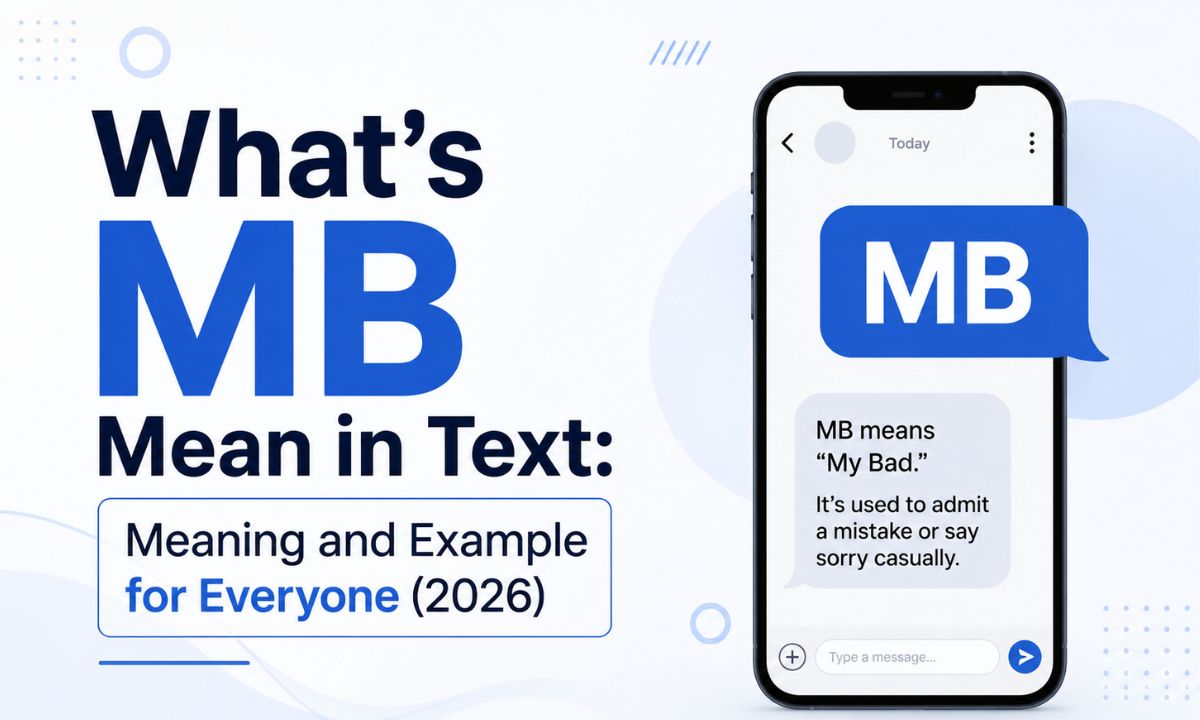

Ever spotted “MB” in a chat and frozen for a second wondering what it means? You’re not alone. As digital communication moves faster than ever, two-letter abbreviations like MB have become part of everyday conversations across texting apps, social media platforms, and even professional tools. Whether you’re a parent trying to decode your teen’s messages, or simply someone who wants to stay current with modern slang, understanding MB can save you from awkward misunderstandings.
The tricky part? MB doesn’t have just one meaning. Depending on who’s typing it and where, it can shift between a casual apology, a noncommittal reply, a request, or even a technical term in computing, medicine, or aviation. This complete 2026 guide breaks down every interpretation of MB — with real examples, platform-by-platform usage, and tips on how to respond — so you never have to guess again.
Meaning & Definition
At its core, MB is a versatile abbreviation with multiple meanings depending on context:
| Meaning | Full Form | Context |
| My Bad | Apology for a minor mistake | Texting, social media, gaming |
| Maybe | Expression of uncertainty | Casual chat, dating apps |
| Message Back | Request to reply | Fast-paced text conversations |
| Megabyte | Unit of digital storage | Computing, tech discussions |
| Mind Blown | Expressing shock or amazement | Social media reactions |
The most widely used meaning in everyday digital communication is “My Bad” — a relaxed, informal way of admitting fault without sounding overly serious.
Background
The phrase “my bad” has its roots in 1970s American slang, but it didn’t hit mainstream pop culture until the mid-1990s. The 1995 teen comedy Clueless played a significant role in popularizing it, with characters using it as a lighthearted admission of fault. From there, the phrase spread rapidly through casual American English.
As smartphones and character-limited platforms took over communication, people began shortening common phrases to save time. “My bad” became “MB” — a two-letter shortcut that carries the same laid-back energy in a fraction of the keystrokes. By the early 2010s, MB had cemented itself in texting culture, and today it’s used across every major social platform, from WhatsApp group chats to TikTok comment sections.
Usage in Different Contexts (Chat, Social Media, Professional Fields)
In Chat & Casual Messaging
In everyday texting, MB almost always means “my bad.” It’s the digital equivalent of a quick shoulder shrug — acknowledging a slip-up without turning it into a big deal. You’ll see it used when someone:
- Sends a message to the wrong person
- Forgets to reply for a while
- Makes a typo or shares wrong information
- Misses a plan or appointment
Example:
“Oh MB, I thought the meeting was at 3, not 2!”
It can also mean “maybe” when someone is undecided or hedging a response.
“Are you coming tonight?” — “MB, depends on work.”
On Social Media
On platforms like Twitter/X, Reddit, and Instagram comment sections, MB often takes on a more expressive role. Users may drop it as a quick reaction — sometimes meaning “mind blown” when paired with 🤯 — or use it as a casual apology after posting incorrect information.
“That plot twist?? MB 🤯”
In Professional Fields
MB rarely belongs in formal emails or official documents. However, in relaxed workplace environments like Slack or Microsoft Teams, some colleagues might use MB informally among peers. In IT and tech discussions, MB will almost always refer to megabyte, a unit of digital data storage.
Meaning in Chat, WhatsApp, Instagram, TikTok
Chat / WhatsApp
WhatsApp is where MB thrives most naturally. In group chats or one-on-one threads, it’s the go-to shorthand for a casual apology. Sending a message to the wrong chat, missing someone’s update, or forgetting to follow through on something? MB covers it smoothly.
Person A: “Wait, did you mean to send that here?” Person B: “Oops, MB! That was for someone else 😅”
On Instagram, MB appears in DMs and comment threads. It’s used to apologize for delayed replies, react to shocking news, or express uncertainty about plans. In captions, some users even use lowercase “mb” in a self-aware, humorous tone.
Caption: “Showed up 30 minutes late to my own birthday. mb 😬”
TikTok
TikTok has given MB a slightly more theatrical spin. In comments, it often expresses genuine shock or disbelief — closer in meaning to “mind blown” — especially in reaction to surprising videos.
“That ending?? MB, I didn’t see that coming 🤯”
In stitches and duets, creators also use MB in a self-deprecating, humorous way to acknowledge their own mistakes.
Overall Trend
Across all platforms, MB usage is growing. Its flexibility — able to mean an apology, uncertainty, or amazement — makes it universally adaptable. The lowercase version “mb” signals a more casual, Gen Z tone, while uppercase “MB” can feel slightly more deliberate or tech-adjacent.
Read Also:JSP Mean in Text Explained Simply—Just for You (2026)
Meaning in Physics, Medical, and Aircraft Terminology
Physics
In academic and scientific contexts, MB stands for the Maxwell-Boltzmann distribution, a foundational concept in thermodynamics and statistical mechanics that describes the speed distribution of particles in a gas. You’ll find this usage exclusively in textbooks, research papers, and university coursework — never in a text message.
MB can also represent millibar (mb) or millibarn, both units of measurement used in physics and atmospheric science.
Medical Field
In medicine, MB is used as shorthand in several ways:
- MB — abbreviation for Mycobacterium bovis, a bacterium responsible for tuberculosis primarily in cattle but capable of infecting humans
- M.B. — stands for Medicinae Baccalaureus (Bachelor of Medicine), a primary medical degree awarded in the UK and many Commonwealth countries
- MB in lab reports may refer to muscle biopsy or medical billing shorthand, depending on the clinical context
Medical professionals rely heavily on surrounding terminology (like MRI, CBC, or other abbreviations) to avoid interpretation errors, since MB alone is ambiguous even within healthcare.
Aircraft Terminology
In aviation, MB carries two important meanings:
- Magnetic Bearing — the compass direction of a target or waypoint relative to magnetic north, measured in degrees. This is a critical navigation term used by pilots and air traffic controllers.
- Marker Beacon — a VHF radio beacon used in conjunction with instrument landing systems (ILS) to help pilots determine their exact position along an approach path to a runway.
Additionally, in aviation maintenance documentation, MB can appear as an abbreviation for Maintenance Bay, referring to a designated aircraft servicing area.
Common Misconceptions
Understanding MB seems straightforward until the wrong context trips you up. Here are the most common misunderstandings people have — and the truth behind them.
Misconception 1: MB always means “my bad.” This is the most common one. While “my bad” is the dominant meaning in texting, MB can easily shift to “maybe,” “message back,” or “mind blown” depending on the flow of conversation. Reading just the abbreviation without considering tone, emoji, or conversation topic is a reliable way to misread the intent.
Misconception 2: MB is only used by teenagers. While MB is especially popular among younger users, it’s used across a wide age range in digital communication. Adults in casual Slack channels, gaming communities, and group chats use it regularly. It’s less a generational marker and more a reflection of fast-paced digital culture.
Misconception 3: Uppercase MB and lowercase mb mean the same thing. Not always. Uppercase MB is more commonly associated with technical usage — megabytes, magnetic bearing — while lowercase mb tends to feel more casual and slang-adjacent. In texting, both appear interchangeably, but in professional or technical writing, the case distinction can carry meaning.
Misconception 4: Using MB in a serious apology is fine. It isn’t. If someone is genuinely hurt or a situation requires real accountability, dropping a quick “mb” can come across as dismissive or flippant. MB is a tool for minor, low-stakes acknowledgments — not for significant emotional conversations.
Misconception 5: MB is a new term. The underlying phrase “my bad” has been in use for decades. MB as a texted abbreviation became popular through the 2000s and 2010s alongside the rise of SMS messaging and social platforms. It’s a well-established part of digital language, not a fresh invention.
Misconception 6: MB and “sorry” are interchangeable. They’re related but not equivalent. “Sorry” carries emotional weight and is expected in formal or heartfelt situations. MB is the casual, low-key cousin — appropriate when the situation is light, the relationship is comfortable, and over-apologizing would feel forced.
Similar Terms & Alternatives
If MB isn’t quite the right fit, these similar abbreviations and phrases carry comparable meanings:
| Term | Meaning | When to Use |
| My B | My Bad (elongated) | Slightly warmer than MB |
| Sry | Sorry | More formal than MB |
| Oops | Casual acknowledgment | Light tone, similar vibe |
| NVM | Never Mind | Withdrawing a statement |
| IDK | I Don’t Know | Alternative to MB as “maybe” |
| Idk maybe / IKM | Indecision | More explicit than MB |
| ICYMI | In Case You Missed It | Correcting or re-sharing info |
How to Respond to It
If MB = My Bad
Keep it easy and low-key — match the casual energy the sender is putting out.
- “No worries!”
- “All good, don’t stress it”
- “Happens to everyone lol”
Avoid going overboard with reassurance. A simple acknowledgment is all that’s needed.
If MB = Message Back
Respond directly to whatever question or topic prompted the request — they’re asking you to reply, so reply!
- Just answer their question or acknowledge the message.
- If you missed what they were referring to, ask: “What did I miss?”
If MB = Maybe
Treat it like an uncertain “possibly” and follow up for clarity if you need a firm answer.
- “Let me know when you decide!”
- “No rush, just let me know”
- If you need a commitment: “Just need to know by tonight if you’re coming”
If MB = Megabyte
This usually appears in a tech or storage-related discussion. Respond in kind — no slang required.
- “Yeah, 500MB should be plenty for that file”
- “The limit is 25MB per attachment”
Differences from Similar Words
It helps to know how MB stacks up against terms that serve a similar purpose:
| Term | Tone | Situation |
| MB (My Bad) | Casual, breezy | Small mistakes in chat |
| Sorry | Sincere, formal | Emotional or serious situations |
| My apologies | Professional | Workplace or formal communication |
| Oops | Playful, lighthearted | Accidental minor slip |
| My mistake | Neutral, direct | Moderately serious contexts |
The key differentiator for MB is its informality and speed. It acknowledges without dwelling. It apologizes without emotionally loading the conversation. Use it where the relationship is comfortable and the error is minor.
Relevance in Online Conversations & Dating Apps

In dating apps like Tinder, Bumble, and Hinge, MB is surprisingly common — and surprisingly useful. People use it to:
- Apologize for a delayed reply (“MB, been swamped at work”)
- Walk back something they said that came off wrong
- Express hesitation when asked about meeting up (“MB, still figuring out my schedule”)
The appeal in dating contexts is that MB softens the blow of imperfect communication without sounding rehearsed or overly apologetic. It signals self-awareness and a relaxed communication style — both attractive traits in early-stage digital conversations.
In gaming communities and Discord servers, MB is equally embedded. Players drop it constantly to acknowledge in-game mistakes, missed coordination calls, or wrong information shared in strategy channels. Its speed is the whole point — the game doesn’t stop, so neither does the language.
Overall, MB has earned its place as one of the most adaptable abbreviations in digital communication. It crosses platform, age group, and context with ease — which is exactly why it’s worth knowing.
Conclusion
MB is one of those abbreviations that seems small but does a lot of heavy lifting in digital communication. Whether you’re reading it as “my bad,” “maybe,” “message back,” or a technical term like megabyte or magnetic bearing, the meaning is almost always clear once you factor in the context. It keeps conversations smooth, quick, and natural — which is exactly what modern texting culture demands.
The bottom line: context is everything with MB. Use it confidently in casual settings, know when to swap it for a more formal phrase, and you’ll navigate both texting and technical conversations with ease. Now that you’ve got the full picture, MB should never leave you guessing again.
