

Every day, millions of texts and social media posts get exchanged using acronyms that not everyone immediately understands. SMD is one of those abbreviations that pops up in casual chats, comment sections, memes, and even professional documentation, but the meaning shifts dramatically depending on where you encounter it. Whether you received an “SMD” message from a friend, spotted it in a TikTok comment, or came across it in an electronics manual, knowing what it actually means in each context can save you from serious misunderstandings. This guide covers everything you need to know about the acronym SMD in 2026.
In everyday digital conversations, SMD most often carries a vulgar slang meaning, but that is only part of the story. The same three letters also appear in electronics engineering as “Surface Mount Device,” in medical research as a statistical term, and in military documentation as a standardized drawing reference. Context is everything when decoding this particular abbreviation. By the time you finish reading, you will have a clear picture of what SMD means across all these spaces, how to recognize which meaning applies, and exactly how to respond when someone sends it your way.
Meaning & Definition
What Does SMD Stand For?
At its core, SMD is an abbreviation with more than one accepted meaning. The interpretation that applies depends entirely on the environment in which it appears. Here is a quick-reference breakdown of the most widely recognized meanings:
| Context | SMD Full Form | Tone / Usage |
| Text / Chat / Social Media | Suck My D*ck | Vulgar, offensive, or playful (depending on relationship) |
| Electronics / Engineering | Surface Mount Device | Technical, professional, neutral |
| Medical / Research | Senile Macular Degeneration | Clinical, diagnostic |
| Statistics / Research | Standard Mean Difference | Academic, analytical |
| Military / Government | Standard Military Drawing | Formal, procedural |
| Social Media (slang variant) | Social Media D**chebag | Satirical, informal |
The slang version is by far the most common meaning encountered in everyday digital communication. However, it is worth being aware of the professional meanings before jumping to conclusions, especially in work-related or academic settings.
Background
Origins and Evolution of SMD Slang
The acronym SMD as internet slang emerged in the early 2000s alongside the explosive growth of SMS texting and early online chat platforms. As character limits and typing speed became everyday concerns, users began compressing offensive phrases, emotional outbursts, and playful jabs into short combinations of letters. SMD found its way into the lexicon of online gaming communities, early social platforms, and hip-hop culture, where bold and confrontational language was already common.
Over time, the acronym migrated from niche forums and direct messages onto mainstream platforms like Twitter, Instagram, and eventually TikTok. The rise of Gen Z internet culture gave it a second wave of usage, often stripped of its original hostility and repurposed as sarcastic humor or exaggerated banter between friends. Today in 2026, the term sits somewhere between genuinely offensive and ironically casual, depending heavily on who is using it and who is on the receiving end.
Usage in Different Contexts (Chat, Social Media, Professional Fields)
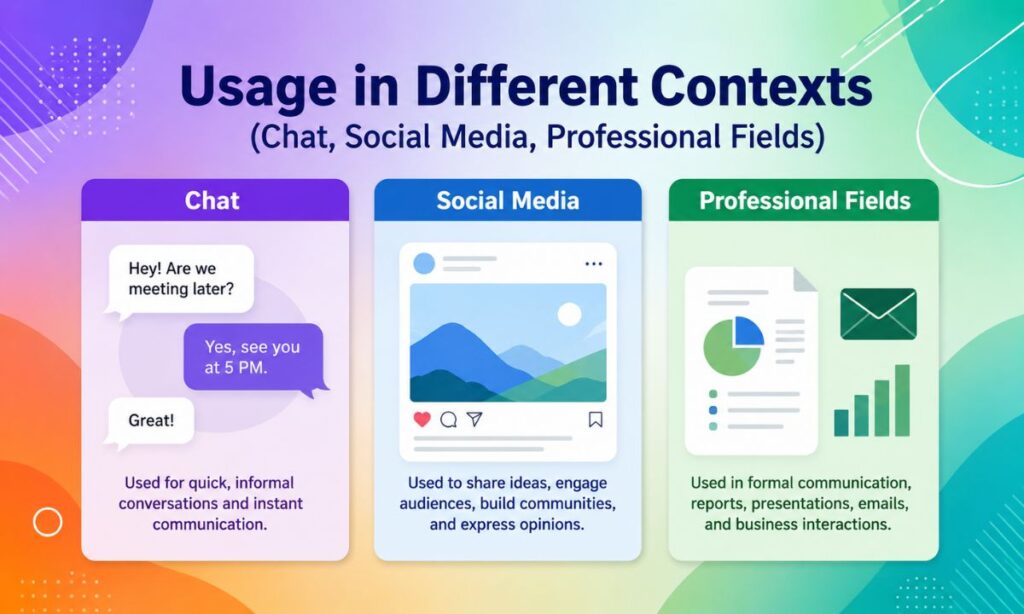
One reason SMD confuses so many people is that it wears completely different hats depending on the environment. Understanding those three distinct environments is the key to accurate interpretation.
In Casual Chat and Text Messages
In private conversations, SMD typically signals one of two things: genuine frustration or playful teasing. When someone is actually angry, the term functions as a dismissal or verbal attack. Among close friends, the same abbreviation can be tossed around as a joke, functioning more like a dramatic eye-roll than an actual insult. The emotional weight is almost entirely determined by prior relationship and conversational tone.
On Social Media Platforms
Comment sections and public posts use SMD differently. On platforms like TikTok and Instagram, it appears in reaction to videos or opinions someone finds annoying, sometimes humorously exaggerated, sometimes genuinely hostile. Memes and viral content have normalized the term to a degree, particularly among younger audiences who deploy it for comedic effect or shock value. Platform moderation teams on Instagram and TikTok do flag and remove explicit language, so users sometimes mask it as “sm*d” or pair it with emoji to bypass filters.
In Professional and Technical Fields
Outside of slang, SMD is a completely neutral and respected abbreviation. Electronics engineers deal with Surface Mount Devices on a daily basis. Researchers in medicine and statistics reference SMD in clinical papers. No offensive connotation exists in these professional spaces, which is why context awareness is non-negotiable before reacting to the term.
Also Read:What Does TTM Mean in Text? Understanding Its Use and Contexts
Meaning in Chat, WhatsApp, Instagram, TikTok
Platform culture shapes how an acronym lands. Here is how SMD behaves across the most popular communication channels in 2026:
| Platform | How SMD Is Typically Used | Risk Level |
| Informal direct messages, often during arguments or jokes between close contacts | Medium — depends on relationship | |
| Instagram DMs / Comments | Reactions to content, frustration in comment threads, sometimes humorous | High — public posts risk moderation |
| TikTok | Comments on videos as a reaction to something annoying or cringe-worthy | High — Gen Z humor often uses it ironically |
| Snapchat | Quick snaps and chat, usually casual or provocative depending on the conversation | Medium — disappearing format makes it casual |
| Discord | Gaming servers and interest groups, often as a joke in friendly fire banter | Low to Medium — community norms vary |
| Dating Apps | Rare; if seen, it likely signals either bold flirtation or outright rudeness | High — easily misread and offensive |
The golden rule across all platforms: if you are not sure whether the person is joking or being serious, pause before reacting. Tone is completely invisible in text, and what reads as funny to the sender may feel genuinely offensive to the recipient.
Meaning in Physics, Medical, and Aircraft Terminology
SMD in Electronics and Physics
In electronics, SMD stands for Surface Mount Device. These are physical electronic components such as resistors, capacitors, diodes, and integrated circuits that are soldered directly onto the surface of a printed circuit board (PCB), rather than being threaded through holes as older through-hole components were. Surface mount technology revolutionized electronics manufacturing by enabling smaller, lighter, faster, and more energy-efficient devices. Every modern smartphone, laptop, smartwatch, and wireless earbud relies on SMD components. In physics and optics, SMD occasionally appears as an abbreviation for Single Mode Device in laser and fiber optic applications.
SMD in Medical Terminology
Medical literature uses SMD in two distinct ways. The first is Senile Macular Degeneration, an older clinical term for age-related macular degeneration (AMD), an eye condition that progressively damages central vision in older adults. The second is Standard Mean Difference, a statistical measure widely used in meta-analyses and systematic reviews to compare outcomes across studies with different measurement scales. If you encounter SMD in a medical journal or clinical report, either of these definitions almost certainly applies.
SMD in Aviation and Military Contexts
The United States military uses SMD to refer to a Standard Military Drawing, which is a standardized product specification document under the MIL-STD-883 framework used to simplify procurement across defense contractors. In aviation technical documentation, SMD can reference Surface Mounted Diodes or similar miniaturized electronic components used in aircraft avionics systems.
Common Misconceptions
Several myths and misunderstandings circulate around SMD online. Here are the most common ones worth clearing up:
• SMD is always offensive: False. In electronics, medicine, and military contexts, it carries zero offensive meaning. Misinterpreting a technical document because of slang familiarity can lead to actual errors.
• SMD only means one thing: Incorrect. The acronym has at least five to six widely recognized meanings depending on the field and context.
• Using SMD as a joke is always safe: Not true. Even between friends, the term can cross a line depending on mood, relationship history, and platform. Many people still find it genuinely offensive even when deployed humorously.
• SMD is only used by men: No. Any gender can and does use this abbreviation in casual texting, typically as a generic expression of frustration or playful sarcasm.
• SMD is a new Gen Z invention: Actually, it originated in early 2000s internet culture and predates most current Gen Z users.
Similar Terms & Alternatives

If SMD feels too aggressive or risky for a given situation, plenty of alternatives express similar emotions with less potential for offense. Understanding the broader family of acronyms helps you navigate digital conversations more confidently.
| Acronym | Full Form | Tone | Best Used When… |
| SMH | Shaking My Head | Mild frustration, disappointment | Reacting to something ridiculous or disappointing |
| IDC | I Don’t Care | Dismissive, detached | Showing indifference without aggression |
| FML | F*** My Life | Self-deprecating, frustrated | Expressing exasperation about your own situation |
| STFU | Shut The F*** Up | Aggressive, commanding | Telling someone to stop, similar intensity to SMD slang |
| KYS | Kill Yourself | Extremely offensive, harmful | Avoid — harmful content flagged on all platforms |
| TBH | To Be Honest | Neutral, candid | Sharing an opinion, completely non-offensive |
| NGL | Not Gonna Lie | Candid, casual | Honest reactions, safe for most contexts |
For expressing frustration without explicit language, phrases like “leave me alone,” “I am not interested,” or even a well-chosen emoji communicate the sentiment clearly and without risk of offense or platform moderation.
How to Respond to It
Receiving an SMD message does not require a dramatic response. Here is a practical approach for different scenarios:
When It Comes from a Close Friend
If the tone is clearly joking, match the humor. A “lol same” or an equally absurd comeback keeps things light. You know your friendship best, so read the room accordingly.
When It Comes from a Stranger or Acquaintance
Stay calm. Responding with equal aggression rarely improves the situation. You can reply with a neutral acknowledgment, ask for clarification, or simply ignore the message. If it feels genuinely threatening or harassing, blocking or reporting is always a valid option.
On Dating Apps
If someone sends SMD on a dating platform, treat it as a significant red flag unless the conversational context is clearly playful and consensual. Most people on dating apps who send explicit unsolicited messages are not worth engaging with. Unmatching is a perfectly appropriate response.
In a Professional Setting
If you see SMD in a work email, technical document, or engineering context, assume the professional meaning: Surface Mount Device or Standard Mean Difference. Do not react as though it is slang without clear evidence that it was intended that way.
Differences from Similar Words
SMD often gets compared or confused with similar-sounding or emotionally adjacent acronyms. Here is how it differs from the closest ones:
| Term | Primary Meaning | Key Difference from SMD |
| SMH | Shaking My Head | SMH is mild and non-explicit; SMD slang is explicitly vulgar |
| STFU | Shut The F*** Up | STFU tells someone to be quiet; SMD is sexually explicit and more aggressive |
| FML | F*** My Life | FML is self-directed frustration; SMD is directed outward at another person |
| IDC | I Don’t Care | IDC is passive and neutral; SMD is confrontational and explicit |
| SMT | Surface Mount Technology | SMT is the process; SMD refers to the actual physical component |
Relevance in Online Conversations & Dating Apps
In the broader landscape of digital communication in 2026, acronyms like SMD reflect how online culture has normalized blunt, abbreviated emotional expression. The speed of social media rewards quick reactions, and short-form slang fills that gap. However, this normalization comes with risks.
On dating apps specifically, the boundaries around explicit language are more sensitive than in friend group chats. Platforms like Tinder, Bumble, and Hinge have community guidelines that explicitly prohibit harassment and unsolicited sexual content. Sending SMD to someone who has not established that kind of conversational tone is a fast track to being reported or banned. Even when used humorously, the lack of tonal cues in text means the other person has no way to distinguish a joke from genuine aggression.
In online discourse more broadly, the term has become a marker of internet literacy. Younger users who grew up with this slang may deploy it casually and mean nothing by it. Older users or those unfamiliar with internet culture may interpret it at face value. Bridging that gap requires situational awareness and, when in doubt, opting for clearer, less ambiguous language.
The technical meanings of SMD are equally relevant in professional online spaces. Electronics hobbyists, engineers sharing PCB designs on Reddit or Discord, and researchers citing meta-analyses in academic forums all use SMD routinely without any connection to slang. Misinterpreting those conversations can create unnecessary embarrassment or miscommunication.
Conclusion
SMD is a genuinely versatile abbreviation that means very different things depending on where it appears. In everyday texting and social media, it carries an explicit and often confrontational slang meaning, though it can also function as sarcastic humor among close friends. In electronics, it refers to the Surface Mount Devices that power modern gadgets. In medicine and research, it appears as Senile Macular Degeneration or Standard Mean Difference. The version you encounter depends entirely on context, platform, and the relationship between the people involved.
Before reacting to an SMD message or using the term yourself, take a moment to assess the environment and your relationship with the other person. In professional or unfamiliar settings, assume the technical meaning. In casual digital conversations, read the tone carefully. When in doubt, there are plenty of less risky ways to express frustration or humor online that carry far less potential for offense or misunderstanding. Staying informed about evolving internet slang is simply part of navigating digital communication effectively in 2026.
