

You are scrolling through your messages and suddenly you see it — two tiny letters, SM. Maybe a friend sent it, maybe someone on Instagram dropped it in your DMs, or a comment on TikTok left you wondering what it actually means. If you paused mid-conversation trying to figure out whether to laugh, reply with love, or send a confused emoji, you are definitely not alone. SM is one of those short abbreviations that looks simple but carries surprisingly different meanings depending on who is talking, on which platform, and in what tone. Understanding it properly saves you from awkward replies and helps you communicate more naturally online.
This guide breaks down the complete SM mean in text picture — from its most common everyday usage as an expression of emotion to its appearance in social media marketing conversations, professional fields, and even aviation and medical terminology. Whether you are a casual texter, a content creator, or just someone trying to keep up with evolving digital slang, this article covers every angle. By the end, you will know exactly what SM means in any situation and how to use or respond to it with full confidence.
Meaning & Definition
At its core, SM is a flexible abbreviation with several recognized meanings. The correct interpretation depends almost entirely on the context in which it appears.
| Abbreviation | Full Form | Primary Context |
| SM | So Much | Casual texting, emotional expression |
| SM | Social Media | Marketing, tech, professional talk |
| SM | Send Me | Direct messaging, requests |
| SM | Sad Mood | Emotional venting, social posts |
| SM | So Many | Quantity emphasis in informal talk |
The most widely used meaning in everyday personal messaging is “so much.” It is short, expressive, and works across a wide range of emotions — from affection to frustration to excitement. The second most common interpretation is “social media,” which dominates in business, marketing, and creator-focused conversations.
Background
The rise of text-based communication in the late 1990s and early 2000s created a need for faster typing. Mobile keyboards were clunky, character limits were real, and people began shortening common phrases into abbreviations. “So much” was a phrase people used constantly — in affection, in gratitude, in frustration — and cutting it down to two letters made perfect sense.
As smartphone usage exploded and platforms like Facebook, Twitter, Instagram, and TikTok became part of daily life, SM gained a second popular meaning: social media. Digital marketers, content creators, and brand managers began using SM as an industry shorthand that eventually crossed into casual speech. Today, SM sits comfortably in both worlds — the emotional texting world and the professional digital marketing world — making it one of the more versatile abbreviations in modern online communication.
Its adaptability is what kept it alive while hundreds of other abbreviations faded. Unlike slang that gets tied to a single moment in internet culture, SM kept picking up new meanings as new contexts emerged, which is a big reason it remains widely searched and used heading into 2026.
Usage in Different Contexts
Casual Chat
In everyday texting between friends and family, SM almost always means “so much” or occasionally “so many.” It amplifies emotion the way an exclamation mark does, but in a quicker, more natural digital-native way. Here are some typical examples you would see in a casual chat window:
• “I miss you sm right now.”
• “Thanks sm for helping me out today.”
• “That movie made me cry sm.”
• “There are sm people at this event, I can’t even move.”
In each of these, SM is doing the same job: adding intensity and emotion without the extra syllables. It fits the minimalist texting style that has been growing steadily with Gen Z and younger millennials, who prefer short, expressive language over full typed-out sentences.
Social Media
On platforms like Instagram and TikTok, SM takes on a slightly broader role. In caption comments and bio text, it often still means “so much,” but in creator and influencer circles it regularly appears as shorthand for “social media” itself. A creator might write “SM presence” or “SM growth tips” in their content to mean social media rather than expressing emotion.
You will also see “SM” used in the context of audience engagement — someone commenting “sm love for this” is expressing appreciation, while a brand post saying “boost your SM reach” is clearly talking about social media platforms.
Professional Fields
In professional and business settings, SM most commonly refers to “social media” and is used in job titles (SM Manager), strategy documents (SM campaign), and marketing reports (SM analytics). Outside digital marketing, SM also appears in other professional contexts:
• Stage Manager — in theatre and live production, the stage manager is often abbreviated as SM in scripts and production schedules.
• Service Member — in military and government communications, SM stands for service member.
• Subject Matter — in training and educational documents, SM Expert or SME (Subject Matter Expert) is common, though the SM part is sometimes used alone informally.
Also Read:FRL Mean in Text Explained Simply—Just for You (2026)
Meaning in Chat, WhatsApp, Instagram, TikTok
The platform you are on often gives the clearest clue about which SM meaning applies. Here is how it breaks down across the major messaging and social platforms:
| Platform | Most Common SM Meaning | Example Usage |
| So Much | “I love this sm” | |
| So Much / Social Media | “SM tips for creators” | |
| TikTok | So Much | “This song hits sm” |
| Snapchat | So Much / Send Me | “sm that pic” |
| Twitter / X | So Much / Social Media | “SM detox needed” |
On WhatsApp, where conversations are typically more personal and private, SM almost always signals “so much” — it is used between close contacts and carries clear emotional intent. Instagram sees both meanings collide more often, especially because the platform attracts both personal users and business accounts in the same feed. TikTok comments lean heavily toward “so much” since the language is fast, expressive, and reaction-driven. Snapchat introduces the “send me” variant fairly often, as in “sm that photo” meaning “send me that photo.”
Meaning in Physics, Medical, and Aircraft Terminology
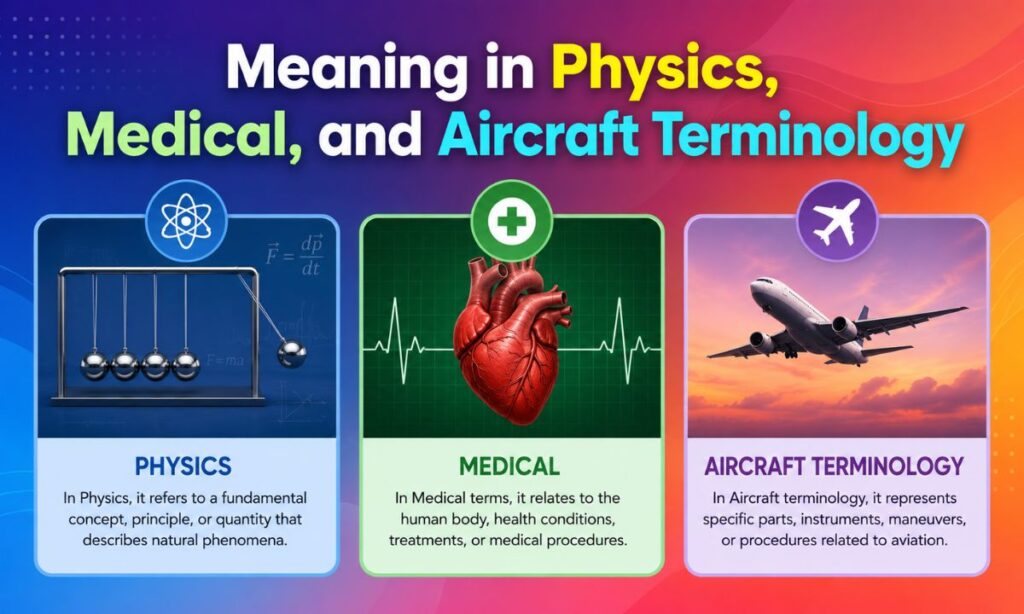
Beyond the world of texting, SM is a recognized abbreviation in several technical and scientific disciplines. Knowing these definitions prevents confusion when you encounter SM in a formal or educational document.
SM in Physics
In physics, SM stands for the Standard Model — the theoretical framework that describes the fundamental particles and forces of the universe (excluding gravity). The Standard Model is one of the most tested and confirmed theories in all of science, covering quarks, leptons, bosons, and the interactions between them. When physicists write “SM particles” or “beyond SM physics,” they are referring to this framework, not to any texting slang.
SM in Medical Terminology
In medical and clinical contexts, SM can refer to Systemic Mastocytosis, a rare disorder involving the abnormal accumulation of mast cells in the body’s organs and tissues. It can also stand for submucous (as in submucosal injection) or appear in anatomical labeling. Medical professionals encountering SM in case notes or clinical literature should always verify the context, as abbreviations in healthcare are highly context-specific.
SM in Aviation
In aviation, SM is the standard abbreviation for Statute Mile, a unit of distance equal to 5,280 feet. It appears regularly in weather reports called METARs (Meteorological Aerodrome Reports), where visibility is reported in statute miles — for example, “3/4 SM” means three-quarters of a statute mile of visibility. Pilots, air traffic controllers, and flight dispatchers work with this abbreviation daily. It also appears in aviation documentation as Standards Manual or Service Message, depending on the operational context.
Common Misconceptions
Because SM is a short, multi-meaning abbreviation, misunderstandings happen more often than people realize. Here are the most common ones to watch out for:
1. SM always means social media. Many people assume this is the default meaning because social media is such a dominant topic online. In reality, in personal chats and emotional conversations, “so much” is by far the more frequent interpretation.
2. SM is rude or inappropriate. Some people have seen SM used in adult-specific contexts (in certain online communities it references sado-masochism). However, this meaning is extremely niche and almost never appears in standard everyday texting or mainstream social media conversations. Assuming this meaning in casual chats would be a significant misread.
3. SM only works in young people’s conversations. While Gen Z and younger millennials use it most frequently, SM appears across age groups, especially in the “social media” sense used by professionals, business owners, and marketers of all ages.
4. SM is always lowercase. Some people think writing “SM” in caps changes the meaning. It does not — “sm” and “SM” carry the same meaning in text. The capitalization is simply a stylistic choice.
Similar Terms & Alternatives
If SM does not quite fit what you want to express, or if you want to avoid ambiguity, here are similar terms and clearer alternatives:
| Term | Meaning | When to Use Instead of SM |
| SO | Intensifier (so good) | When expressing intensity without quantity |
| RLY | Really | Emphasizing truth or feeling |
| V | Very | Short intensifier in UK-style texting |
| TBH | To Be Honest | Sharing a genuine feeling or opinion |
| NGL | Not Gonna Lie | Admitting something with mild vulnerability |
If you want to avoid any ambiguity at all, you can always write out “so much” in full. In a personal message to someone close, “I appreciate this so much” lands just as naturally as “I appreciate this sm” — and leaves zero room for misreading.
How to Respond to It
Knowing how to reply when someone sends SM in your direction is just as important as knowing what it means. The right response depends on the emotional tone of the message:
When SM Expresses Affection or Gratitude
• “Aww, I miss you too sm!”
• “You’re so sweet, thank you sm for saying that.”
• “Same honestly, this meant a lot.”
When SM Is Used as a Request (Send Me)
• “Sure! Sending it now.”
• “On it, give me a sec.”
• “Done — check your DMs.”
When SM Appears in a Sad or Low-Mood Context
• “Hey, are you doing okay? Here for you.”
• “I hear you. Want to talk about it?”
• “That sounds rough. I’m around whenever.”
When SM Is Professional (Social Media Context)
• Match the professional tone of the conversation.
• Reply with relevant context: “Yes, our SM strategy is due by Friday.”
• Do not respond casually if the setting is clearly formal.
The golden rule: mirror the energy of the message. If it is warm and affectionate, be warm back. If it is casual and fun, keep things light. If it seems sad or heavy, lead with care before anything else.
Differences from Similar Words
SM often gets confused with a few other abbreviations that look or sound alike. Here is how to tell them apart:
| Term | Stands For | Tone | Most Common Platform | Example |
| SM | So Much | Warm, emotional | WhatsApp, TikTok | “Miss you sm” |
| DM | Direct Message | Neutral / action | Instagram, Twitter | “Slide into my DMs” |
| OMG | Oh My God | Shocked, surprised | All platforms | “OMG I can’t believe it” |
| LY | Love You | Affectionate | Texts, Snapchat | “LY, talk later” |
| SB | Snap Back | Request / casual | Snapchat | “SB when you’re free” |
The biggest confusion tends to happen between SM and DM, especially when someone says “sm me” (send me) versus “dm me” (direct message me). In practice, “dm me” is far more standard as a request to contact someone privately. If someone says “sm me that link,” they almost certainly mean send me — but in most modern conversations, people would simply say “dm me” or “send me” to avoid any confusion.
Relevance in Online Conversations & Dating Apps
SM has found a very natural home in dating app conversations and romantic digital exchanges. The “so much” interpretation is particularly powerful in these contexts because it expresses genuine emotion without the vulnerability of typing it all out. Consider how much weight sits behind three characters when someone on Hinge or Bumble replies:
• “I like you sm already.”
• “This conversation is making me smile sm.”
• “You get me sm, that’s rare.”
Each of these messages communicates real warmth and attraction in a way that feels natural, not over-the-top. SM in romantic or dating contexts acts as a soft intensifier — it says “this matters to me” without the pressure of a formal declaration. It keeps the conversation flowing and the emotional tone light but genuine.
On the other hand, SM as “social media” also shows up in dating conversations when people are vetting each other or asking to connect beyond the app. Phrases like “are you on SM?” or “let’s connect on SM” are common early-stage conversation moves where someone is ready to move from the dating platform to Instagram or Snapchat without making it feel too serious.
One practical tip for dating app use: if you receive a message with SM and you are not sure which meaning was intended, look at the surrounding context. Is the conversation emotionally loaded? It is probably “so much.” Is someone asking for your handle or profile? It is almost certainly “social media.” Tone and topic together will almost always point you in the right direction.
Conclusion
SM mean in text is one of the most flexible abbreviations in modern digital communication. Whether someone is expressing deep emotion with “so much,” referencing social media platforms, making a quick request to “send me” something, or describing a quiet mood, those two letters do a lot of work in very little space. The key to reading SM correctly every time is simple: look at the platform, look at the emotional tone, and think about what kind of conversation you are in.
Understanding online slang like SM is more than just keeping up with trends — it is about communicating naturally and confidently in the spaces where people connect today. Now that you know every meaning, every context, and how to respond in each situation, you are fully equipped. Bookmark this guide for future reference, and next time SM shows up in your messages, you will know exactly what to do.
