

Pedro Paulo is an executive coach and leadership development strategist known for transforming how professionals approach strategic thinking and organizational leadership. For over a decade, he’s guided emerging leaders and C-suite executives through the complexities of modern business environments. His approach combines psychological insights with practical business acumen, helping leaders develop emotional intelligence and strategic alignment. This guide explores how executive coaching through Pedro Paulo’s framework creates measurable outcomes for professionals seeking career advancement and leadership growth.
Why Pedro Paulo Executive Coaching Is Changing Modern Leadership
The gap between management and true leadership grows wider each year. Most executives rise through technical competence, not through deliberate leadership development. Traditional leadership training programs deliver surface-level knowledge. They rarely address the deeper issues of self-awareness, emotional intelligence, and decision-making skills that separate exceptional leaders from average ones.
Pedro Paulo executive coaching operates differently. Rather than generic seminars, his coaching programs focus on personalized development tailored to individual executives and organizational needs. Through structured assessment and continuous feedback, professionals develop the strategic leadership capabilities required for career advancement at senior levels.
Modern organizations recognize this shift. Companies investing in leadership coaching report stronger team productivity, better succession planning, and improved organizational change management. The difference between effective and ineffective leadership cascades through entire organizations. When senior executives develop strategic thinking skills and emotional mastery, their teams respond with higher engagement and better business results.
Meet Pedro Paulo: A Proven Leader in Executive Coaching
Pedro Paulo entered the business world as a traditional corporate executive. Working in high-pressure environments taught him valuable lessons about human dynamics, organizational development, and what truly motivates professional growth. His early career focused on business operations and team leadership across multiple industries.
Through direct experience, he recognized a critical problem. Most executives received minimal guidance on how to lead effectively. Performance reviews measured results, not leadership quality. Training departments offered courses, but nobody addressed individual coaching needs or the deeper work of building authentic leadership presence.
This observation sparked his transition from corporate management to executive coaching. He invested years in professional development, earning certifications in coaching methodologies, completing training in emotional intelligence assessment, and studying organizational psychology. His corporate background provided credibility that pure coaches often lack. He understood boardroom pressures, stakeholder management challenges, and the real constraints executives face.
From Corporate Boardrooms to Coaching Mastery

Executive leadership requires more than management skills. It requires vision, resilience, and the ability to influence across organizational boundaries. Pedro Paulo’s corporate experience gave him intimate knowledge of these demands.
During his corporate tenure, he held positions that required strategic alignment across departments. He managed organizational change initiatives, built high-performing teams, and navigated complex stakeholder relationships. These experiences revealed patterns. Some leaders thrived despite obstacles. Others with equal intelligence and resources struggled.
The difference wasn’t talent or work ethic. It was self-awareness, communication effectiveness, and the ability to adapt leadership strategy based on context. Executives who invested in understanding their own patterns and impact on others accelerated their career growth. Those who didn’t eventually plateaued, regardless of technical skills.
His transition to executive coaching emerged naturally from these observations. Rather than managing one organization, he could now impact multiple leaders across different industries. His coaching programs draw directly from real boardroom challenges he had navigated personally.
Educational Foundation and Continuous Learning
Credible executive coaching requires ongoing professional development. Pedro Paulo maintains active involvement in coaching certifications, advanced training programs, and research in leadership development.
His educational foundation includes specialized training in coaching psychology, assessment tools like 360-degree feedback methodologies, and evidence-based coaching approaches. He studies emotional intelligence frameworks, executive performance metrics, and organizational development theory.
Professional affiliations keep his work aligned with industry standards. Regular attendance at leadership coaching conferences, participation in peer coaching communities, and continuous learning about emerging leadership trends inform his practice. This commitment to continuous learning ensures his coaching methodology stays current with modern business needs.
Recognitions and Credentials
Third-party validation matters when selecting an executive coach. Pedro Paulo’s credibility rests on demonstrated results with clients across industries, recognition from peers in the coaching profession, and features in relevant business publications.
His certifications include specialized training in:
- Executive coaching certification through accredited coaching organizations
- Psychometric assessment and 360-degree feedback administration
- Emotional intelligence development and assessment
- Organizational development and change management
Media features and client testimonials provide evidence of impact. Executives he has coached advance into senior positions, lead successful organizational transformations, and report improved work satisfaction. These concrete outcomes matter more than any single credential.
Why Pedro Paulo Executive Coaching Stands Out
Hundreds of executive coaches operate in the United States. What differentiates one from another often comes down to methodology, experience, and results.
Pedro Paulo’s executive coaching approach combines several distinctive elements:
- Personalized assessment before coaching begins
- Focus on emotional intelligence and self-awareness alongside skill development
- Integration of organizational context into individual coaching
- Clear metrics tracking progress and business results
- Accountability systems that support sustained behavior change
Many coaching programs treat every executive similarly. They apply generic frameworks regardless of individual circumstances, industry context, or specific challenges. Pedro Paulo executive coaching starts with discovery. Every engagement begins with thorough assessment of the leader’s strengths, development areas, and organizational environment.
This personalization matters. An executive leading organizational change needs different coaching than one preparing for a board role. An emerging leader navigating their first management position requires different guidance than a senior executive developing succession plans. One-size-fits-all approaches inevitably miss critical nuances.
The 5 Pillars Framework of Pedro Paulo Executive Coaching
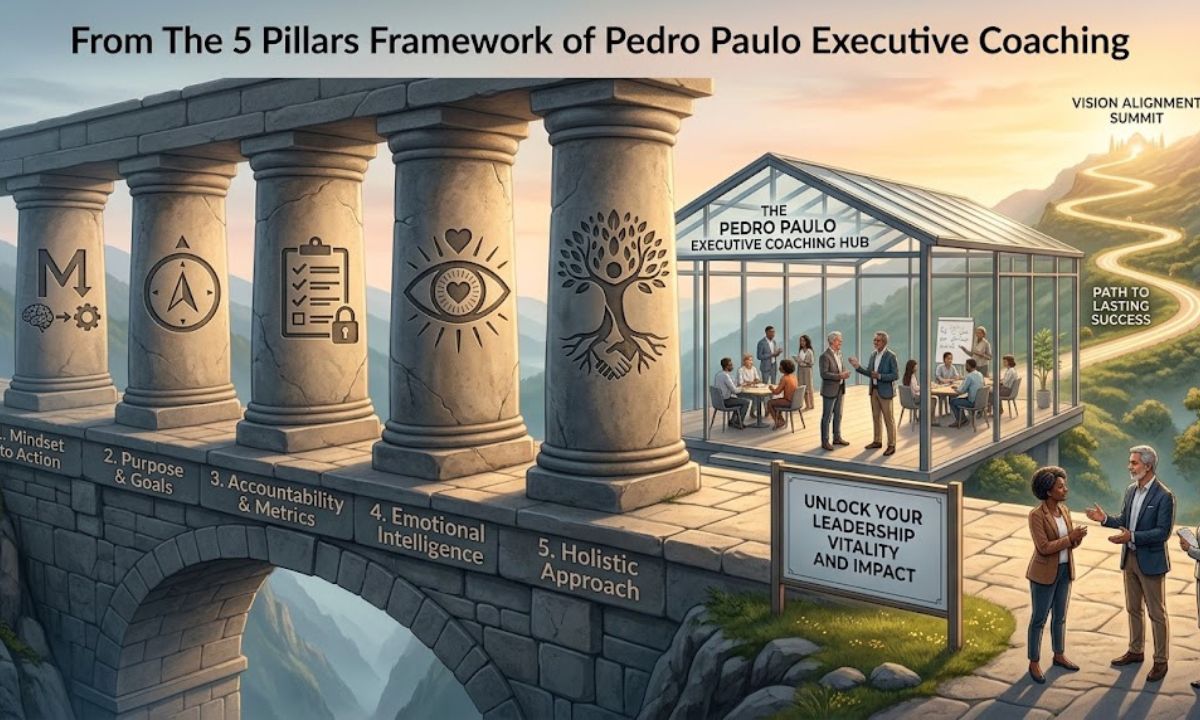
The foundation of Pedro Paulo’s executive coaching methodology rests on five interconnected pillars. These pillars address the complete development of leaders across technical and interpersonal domains.
Pillar 1: Self-Awareness and Emotional Intelligence
Leaders who lack self-awareness create unintended consequences. They misread situations. They trigger defensive responses in their teams. They make strategic decisions based on incomplete information about their own motivations.
Self-awareness through executive coaching involves structured reflection and feedback. Using 360-degree feedback, psychometric evaluations, and coaching conversations, leaders identify blind spots. They understand how their communication style impacts others. They recognize patterns in their decision-making. This foundation enables every other development area.
Emotional intelligence builds on self-awareness. It’s the ability to recognize and manage emotions in yourself and others. Leaders with strong emotional mastery navigate conflict effectively, build genuine relationships, and maintain resilience under pressure.
Pillar 2: Strategic Leadership and Goal Setting
Coaching helps executives develop stronger strategic thinking capabilities. Rather than reacting to immediate pressures, strategic leaders align daily actions with long-term vision.
This pillar addresses vision clarity, goal setting using SMART-R frameworks, and strategic alignment across the organization. Coaches help leaders define what success looks like, identify key priorities, and build accountability systems that keep teams focused on business results.
Pillar 3: Communication Effectiveness and Influence
Leadership presence depends on communication. Executives who articulate vision clearly gain organizational buy-in. Those who listen deeply build trust and strengthen relationships.
This pillar develops presentation skills, stakeholder management capabilities, and the ability to influence without authority. Coaching addresses how leaders frame messages for different audiences, navigate difficult conversations, and build credibility across organizational levels.
Pillar 4: Team Dynamics and High-Performing Teams
A leader’s impact multiplies through their team. Coaching helps executives build psychologically safe environments where team engagement flourishes. It addresses delegation strategies that develop capabilities in others, conflict resolution approaches, and team productivity optimization.
Pillar 5: Resilience and Sustainable Leadership
Executive burnout damages both individuals and organizations. This pillar develops the resilience, stress management, and work-life integration strategies that enable sustained high performance without burnout.
Differentiators vs. Traditional Coaching Models
Traditional leadership training programs deliver content in classroom settings. Attendees sit through presentations, discuss case studies, and return to work with binders of notes. Within weeks, the insights fade. Behaviors remain unchanged. Training rarely produces lasting transformation.
Why? Because learning happens through experience and application, not through information transfer.
Executive coaching differs fundamentally. It’s personalized, ongoing, and accountability-focused. Rather than generic content, coaching addresses specific challenges the executive faces. Rather than one-time sessions, it involves regular contact that supports sustained behavior change. Rather than hoping participants apply learning, coaches hold leaders accountable for concrete actions.
Pedro Paulo executive coaching combines the personalization advantage of coaching with structured frameworks that provide consistency. Clients receive customized action plans based on their assessment results. They work with the same coach over months or years, enabling deeper work than single consultations allow.
The result shows in business outcomes. Organizations report stronger team productivity, faster career advancement for developed leaders, and improved organizational change management from coaching investments compared to traditional training programs.
Also Read This : Paul J. Mauro Biography: Career, Family and Early Life
Services and Program Structure
Pedro Paulo offers multiple engagement models to match different needs and budget considerations.
Assessment and Discovery Process
Every engagement begins with comprehensive assessment. This includes:
- Individual interviews exploring background, aspirations, and challenges
- 360-degree feedback from peers, direct reports, and supervisors
- Psychometric evaluations assessing behavioral patterns and communication preferences
- Organizational context analysis understanding team dynamics and business pressures
From this assessment emerges a customized action plan identifying the three to five key development areas. Success metrics get defined upfront. Both coach and client understand what improvement looks like.
Coaching Engagement Models
Monthly sessions represent the standard engagement structure. These typically occur for six to twelve months, though some executives continue longer. Sessions might be in-person or virtual depending on preference and location.
Between sessions, clients apply coaching insights to their work. They complete assigned reading or reflection exercises. They practice new skills in real organizational situations. The coach provides accountability and guidance through these implementation efforts.
Pedro Paulo Executive Coaching for Emerging Leaders
Emerging leaders face particular challenges. They’ve proven technical competence in previous roles. Now they must develop team leadership capabilities, strategic thinking, and executive presence simultaneously.
Coaching for emerging leaders focuses on accelerating their transition into leadership effectiveness. Rather than learning through trial and error over years, emerging leaders get guided development that compresses the learning curve.
Programs for emerging leaders address:
- Building leadership credibility with new teams
- Transitioning from individual contributor to team leader
- Developing emotional intelligence for relationship building
- Learning delegation and coaching skills
- Building executive presence
- Navigating organizational politics effectively
Many high-potential professionals struggle in their first leadership roles simply because nobody has prepared them for the interpersonal demands of management. Coaching fills this gap, enabling emerging leaders to develop faster and progress toward senior positions with stronger foundations.
Advanced and Platinum Programs for Senior Executives
Senior executives and C-suite leaders face different coaching needs. They’re typically not struggling with basic leadership skills. Instead, they’re navigating board-level relationships, driving organizational transformation, building legacy, and planning succession.
Pedro Paulo’s advanced programs for senior executives address:
Board Readiness Coaching: Preparing executives for board roles requires understanding governance, fiduciary responsibilities, and board dynamics. Coaching helps executives make the transition from operational leadership to governance effectively.
Organizational Transformation: Senior leaders often drive major organizational change. Coaching helps them develop the strategic alignment, stakeholder management, and resilience required for transformation success.
Executive Team Alignment: C-suite cohesion directly impacts organizational performance. Coaching addresses how executive teams work together, resolve conflicts constructively, and maintain alignment on strategy.
Succession Planning: Creating leadership pipelines requires intentional development. Coaching helps senior executives mentor emerging leaders and build organizational bench strength.
Platinum programs provide premium access. Clients receive more frequent coaching, integration with organizational strategy, and sometimes team coaching alongside individual development.
Specialized Workshops and Team Alignment Sessions
Beyond individual coaching, Pedro Paulo delivers workshops addressing specific organizational needs.
Leadership team workshops bring executive groups together for facilitated development. These address:
- Strategic alignment and shared vision
- Team communication and trust building
- Organizational change management
- Culture development and values alignment
- Conflict resolution and difficult conversations
Workshops use experiential learning methods. Rather than lectures, participants engage in interactive exercises that build skills directly applicable to their work. They leave with stronger relationships with peers and improved alignment on critical strategic questions.
Benefits, ROI and Success Stories
Leaders who engage in coaching experience measurable improvements across multiple dimensions.
Individual Leader Benefits:
- Improved decision-making skills through self-awareness and strategic thinking
- Enhanced leadership presence and communication effectiveness
- Accelerated career advancement into senior positions
- Stronger relationships with peers, supervisors, and teams
- Increased job satisfaction and work engagement
- Greater resilience and stress management
Organizational Benefits:
- Improved team productivity from better leadership
- Stronger retention of high-performing leaders
- Faster organizational change implementation
- Better succession planning and leadership pipelines
- Improved organizational culture and employee engagement
- Better business results from stronger strategic alignment
These benefits justify coaching investment. Organizations report return on investment ranging from 300% to 500% when measuring improved retention, faster advancement, and business impact.
Quantifying Success: Metrics That Matter
Effective coaching tracks progress through concrete metrics.
Individual Progress Metrics:
- 360-degree feedback scores improvement (measured at coaching start and end)
- Goal achievement rate on customized action plans
- Leadership competency development in specific areas
- Promotion or advancement outcomes
- Team engagement and direct report satisfaction
- Stress and burnout levels
Organizational Metrics:
- Leader retention rates
- Time-to-leadership-effectiveness for new executives
- Team productivity improvements
- Organizational change adoption rates
- Employee engagement survey results
- Business performance metrics like revenue and customer satisfaction
Tracking these metrics ensures coaching produces measurable business results, not just subjective improvement.
Real-World Changes: Client Case Studies
Case Study 1: The Emerging Leader’s Acceleration
James, a technical expert, was promoted to lead an engineering team. Within three months, his direct reports reported frustration with his leadership style. He was intelligent and technically sound but lacked emotional intelligence in interpersonal situations. He gave feedback harshly. He dominated meetings rather than developing his team.
Through Pedro Paulo executive coaching, James worked on emotional intelligence and communication effectiveness. He learned to recognize his impact on others. He developed coaching skills for his direct reports. Within six months, team engagement scores improved 35%. Two members who were considering leaving recommitted to the team.
Within eighteen months, James was promoted to director level. His success in developing his team made him attractive for promotion. Coaching compressed what might have taken years into rapid career acceleration.
Case Study 2: The Overwhelmed Senior Executive
Maria, a VP of Operations, faced organizational transformation. The company was consolidating divisions. She had to reorganize her team, implement new processes, and maintain performance during uncertainty. She felt overwhelmed and questioned her capability.
Coaching provided the accountability and strategic guidance she needed. Her coach helped her break the transformation into manageable pieces. They worked on stress management and building resilience. They developed a communication strategy that kept teams engaged despite uncertainty.
Maria successfully led the transformation on time and under budget. Employee engagement actually improved during the transition because people understood the vision and felt supported through change. Her reputation as a transformational leader strengthened significantly.
Case Study 3: The Team Alignment Challenge
An executive team at a mid-sized technology company suffered from dysfunction. Silos prevented collaboration. Executives competed rather than coordinated. Strategic decisions took months because consensus was impossible.
Pedro Paulo facilitated both individual executive coaching and team workshops. The team addressed underlying trust issues. They clarified their strategic vision together. They developed conflict resolution skills. Within four months, decision-making time decreased 40%. Strategic initiatives that had stalled moved forward.
The team went from being a liability to being a competitive advantage. Culture improved throughout the organization because the leadership team modeled healthy conflict and collaboration.
Long-term Career Impact
Coaching produces effects that extend far beyond the formal engagement period.
Executives who develop self-awareness and emotional intelligence don’t lose these capabilities. They continue applying coaching insights years after coaching concludes. They become stronger mentors to their teams. They model continuous learning and personal development.
Many clients return for coaching at different career stages. An emerging leader who worked on team building returns years later preparing for board roles. A senior executive returns to work on succession planning. The relationship and trust established during initial coaching makes follow-up engagements more effective.
Beyond individual outcomes, coached leaders create ripple effects. They develop their own teams more effectively. They build stronger organizational cultures. They mentor emerging leaders using frameworks they learned through coaching. The impact multiplies across organizational levels and time.
Organizational Impact on Culture and Performance
Leadership development at the executive level reshapes entire organizations.
When senior executives improve their emotional intelligence and communication effectiveness, their teams respond. People feel heard and valued. Psychological safety increases. Team engagement improves. Productivity accelerates because people aren’t wasting energy on office politics or defensive behaviors.
When executives develop stronger strategic alignment, organizations move faster. Decisions get made with clarity about direction. Resources concentrate on priorities. Competing initiatives dissolve. Focus increases business results.
When leaders model continuous learning through coaching, organizational culture shifts. Development becomes valued. People see growth as possible. Retention improves because people see pathways for advancement. Future leaders develop within the organization rather than being recruited externally.
Organizations that invest in senior leadership coaching create measurable advantages in employee retention, organizational agility, and business performance.
The Coaching Journey: From Assessment to Ongoing Support
Phase 1: Assessment and Discovery (Week 1-2)
The coaching relationship begins with thorough assessment. The coach and client explore background, goals, challenges, and aspirations. 360-degree feedback gets administered. Psychometric evaluations provide insight into behavioral patterns. From this data emerges clarity about the coaching focus.
Phase 2: Active Coaching Engagement (Month 1-9)
Regular coaching sessions begin, typically monthly. Between sessions, clients apply coaching insights to their work. They practice new skills. They reflect on impact. They report progress in subsequent sessions. Coaching becomes integrated into their professional life.
Phase 3: Integration and Independence (Month 10-12)
Coaching frequency decreases as clients internalize frameworks and become more self-directed. The focus shifts from external accountability to internal drive. Clients develop the ability to recognize when they’re falling back into old patterns and self-correct.
Phase 4: Ongoing Support
Even after formal coaching ends, relationships often continue. Clients schedule periodic sessions when facing new challenges. They stay connected to coaching community. They become mentors to others beginning coaching journeys.
Frequently Asked Questions
Who benefits most from executive coaching?
Emerging leaders stepping into management roles, senior executives preparing for board positions, leaders navigating organizational change, high-potential professionals seeking accelerated development, and executives feeling stuck in their career advancement.
How long does coaching typically take?
Most engagements run six to twelve months with monthly sessions, though some executives continue longer and some complete focused work in shorter timeframes.
What’s the investment?
Costs vary based on program level and frequency, typically ranging from moderate to significant annual investment that returns through improved performance and career advancement.
How is confidentiality maintained?
Everything discussed in coaching remains confidential between coach and client, with the exception of legally required disclosures.
What if coaching doesn’t work?
Most clients see significant progress within the first three months. If progress stalls, the coach and client explore what’s not working and adjust approach, though coaching requires genuine commitment from the client.
Conclusion
Pedro Paulo executive coaching transforms how professionals approach leadership development and career growth. Rather than hoping leaders develop through experience alone, coaching provides guided development that accelerates progress. Through personalized assessment, strategic frameworks, and ongoing accountability, executives build emotional intelligence, strengthen decision-making skills, and develop the strategic thinking required for sustained advancement.
The evidence is clear: coaching works. Individual leaders advance faster into senior positions. Teams become more productive. Organizations perform better. In competitive business environments where leadership quality matters increasingly, executive coaching represents one of the highest-impact investments organizations can make in their future.
